⚠️ Note: This guide pertains to Genealogy Quebec’s legacy tools, which are no longer updated. Please refer to this guide for the most up to date way to use the website.
On the site, you will find over 50 million images and files that will allow you to retrace the history of your family in Quebec and the surrounding area. These documents are divided into several tools. In order to get the most out of the website, it is important to know which tool to refer to depending on the nature of your research.
Your first search on Genealogy Quebec
Whether you are looking for an individual in particular or want to trace an entire line, your first search on the site is likely to be on the LAFRANCE.
The LAFRANCE contains millions of births, marriages and deaths from Quebec, Ontario, Acadia and the United States from 1621 to the present day. It is with these records, and specifically marriages, that you will be able to trace your ancestry.
Tracing a lineage on Genealogy Quebec
To trace a lineage, you will have to begin by finding a marriage belonging to that line on the LAFRANCE. If you are looking for your own lineage, your parents, grandparents or great-grandparents’ marriage is a good place to start.
The parents of the spouses will generally be listed in a marriage record. By searching for the parents’ names in the LAFRANCE, you should be able to find their marriage and, as such, go back one generation in the line. Thus, you can trace an entire lineage through the chain of marriages of the individuals forming it.
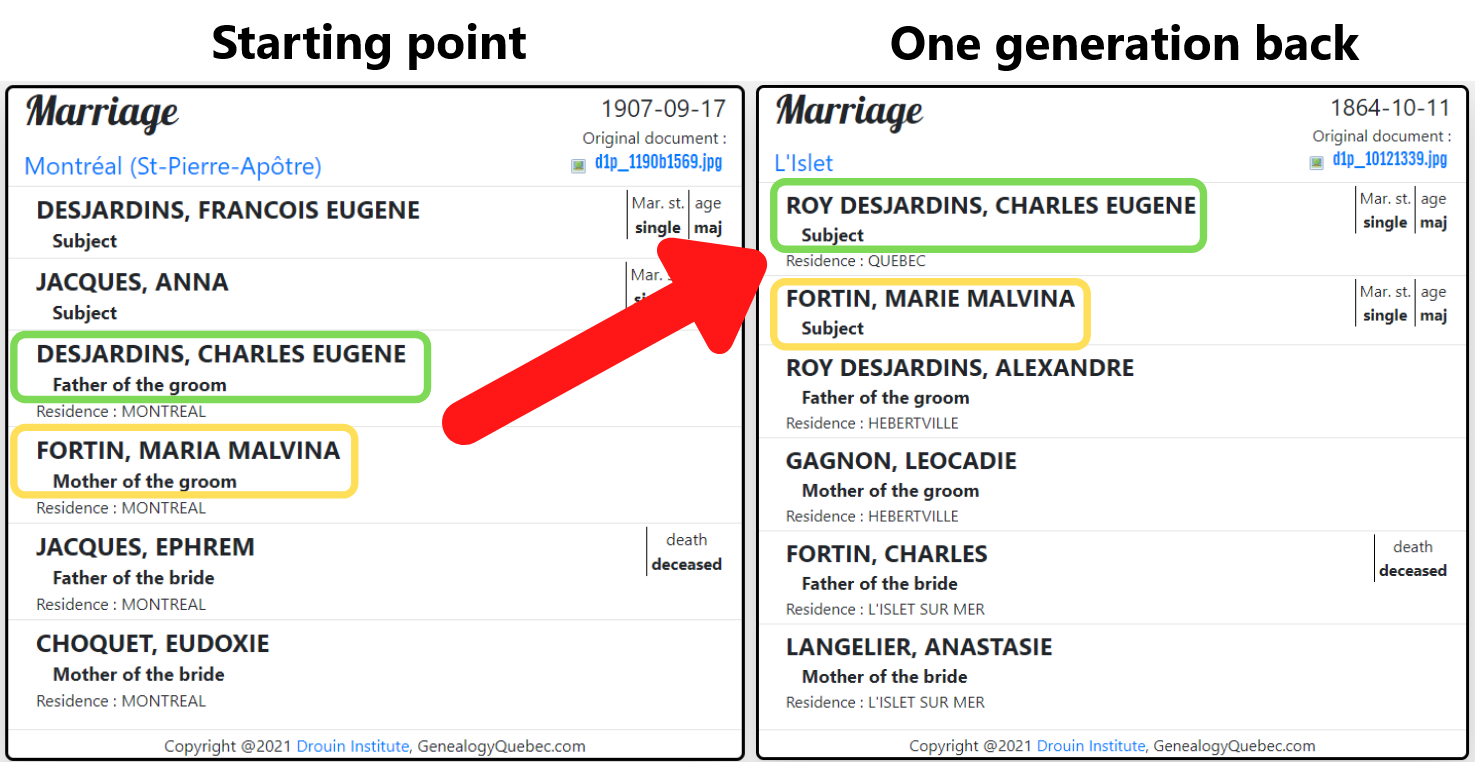
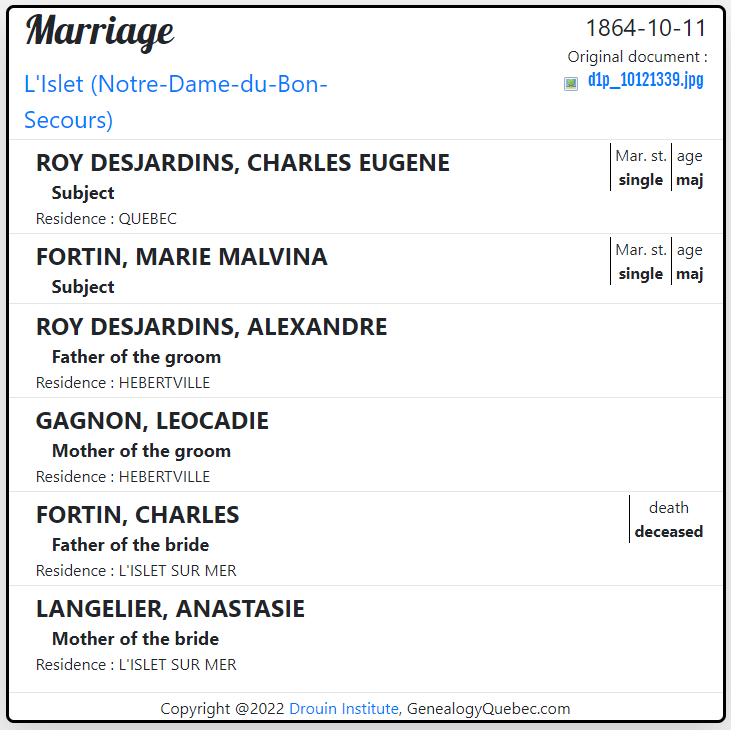
The names of the groom’s parents are listed in the marriage on the left. Searching for them in the LAFRANCE allows us to find their marriage. By repeating the process, we can go back to the first immigrant of a lineage in Quebec territory.
You will find a guide detailing this process at this address.
Tip: Can’t find the marriage you are looking for? Try limiting your search queries to the last names of the spouses, or try different variations of the search such as the first name of the husband and the last name of the wife, or the last name of the husband and the first name of the wife. By doing so, you limit the risk of the record being excluded from the results of your search, which can occur when one of the search queries does not match the information contained in the document.
Advanced search and other types of documents
In addition to its collections of births, marriages and deaths, Genealogy Quebec offers a multitude of tools containing documents of all sorts.
For example, all obituaries, tombstones and memorial cards on the site can be found in the Obituary section.
Genealogy Quebec also allows you to search for births, marriages and deaths that may not be listed in LAFRANCE by using the Connolly File, NBMDS, and BMD Cardscollections.
You can find a detailed list of the tools and their contents on the Tools page.
Tip: We recommend that you keep your searches vague, and refine them if necessary by adding one piece of information at a time. When the first or last name you are looking for is unusual, it is seldom necessary to add more information to a search.
The more detailed a search, the more likely it is to omit the result you are looking for, as all the search queries must match the document. For example, your first search could start with the last names of the spouses. If the number of results is too high, you may add an additional variable such as a first name or a year.
⚠️ Note: This guide pertains to one of Genealogy Quebec’s legacy tools, which are no longer updated. Their content is now integrated into the new unified search engine.
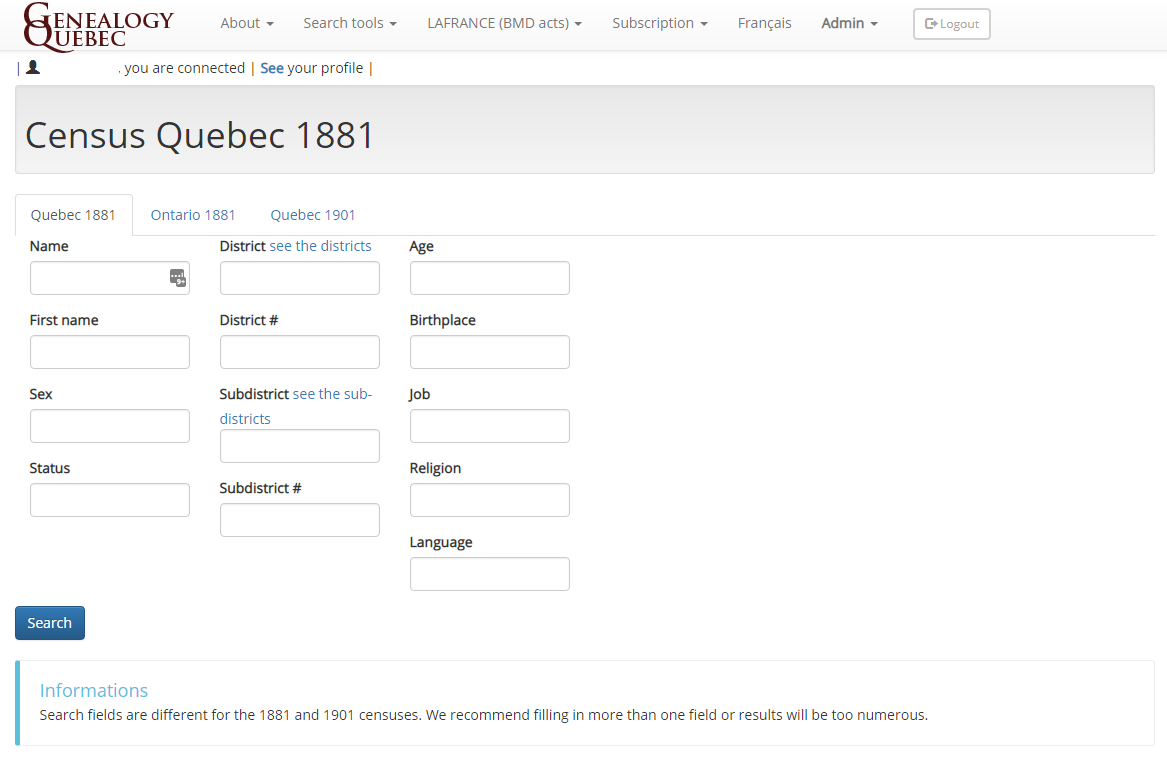
The Census 1881-1901 tool contains a detailed index of the 1881 and 1901 censuses from the province of Quebec, as well as the 1881 census from the province of Ontario.
This tool indexes a total of 5 012 907 individuals.
The search engine allows you to search in every field contained in the census. Note that these fields differ by census.
1881 Quebec census fields:
Name
First name
Sex
Status
District
District #
Sub district
Sub district #
Age
Birthplace
Religion
Language
1901 Quebec census fields:
Name
First name
Sex
Status
District
District #
Sub district
Sub district #
Age
Year
Month
Day
Family relationship
1881 Ontario census fields:
Name
First name
Sex
Status
District
District #
Sub district
Sub district #
Age
Birthplace
Religion
Language
Here is the list of districts available per census:
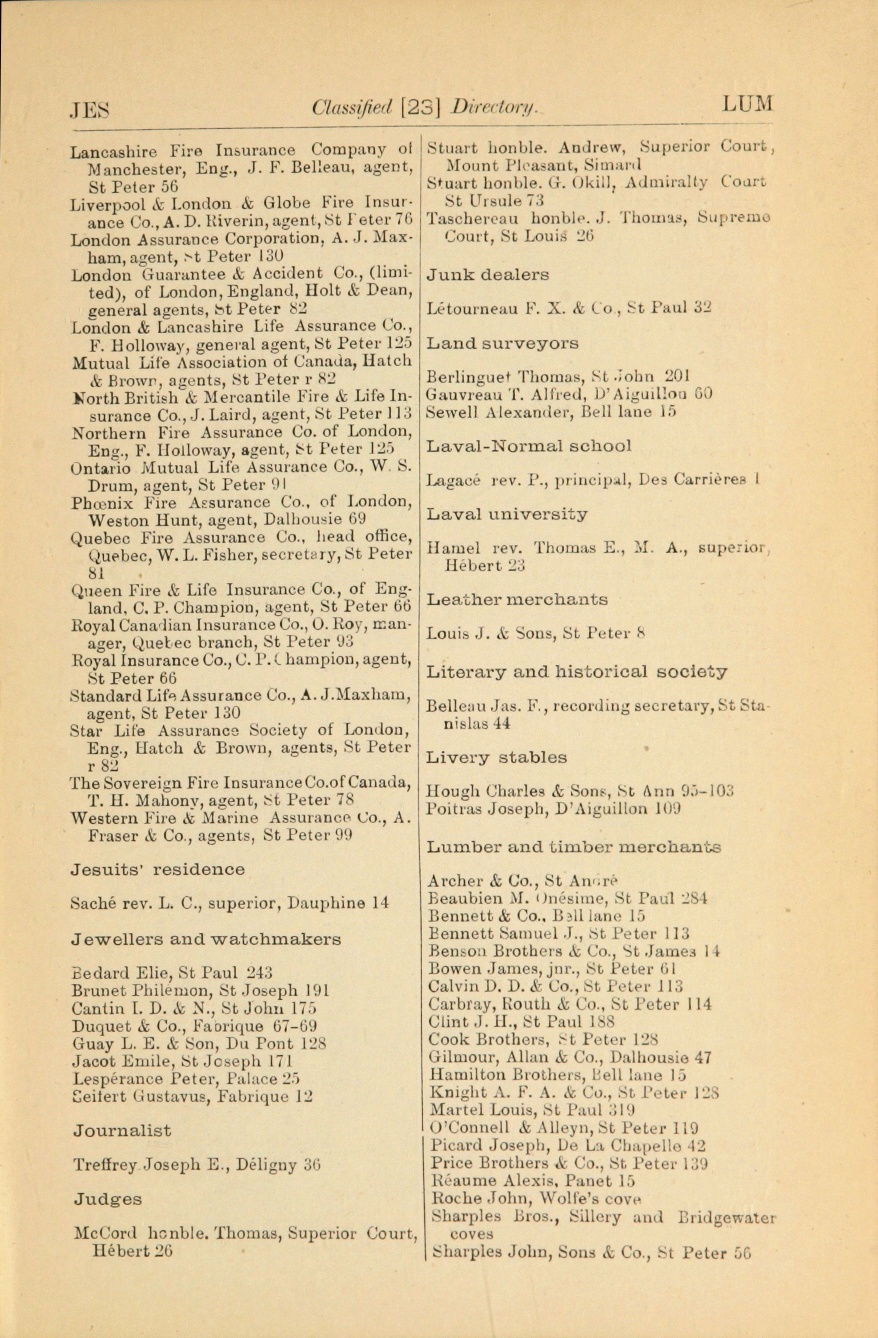
The City directories tool contains a digitized version of the city directories of Montreal (Lovell), Laval (Lovell) and Quebec (Marcotte). The directories have been digitized and indexed by year and category.
Within the directories, you will find the following categories:
Introduction – Contains the cover page, a preface, as well as a table of contents
Index to Streets, Avenues, Lanes – An index of the streets, avenues and lanes of the city
Index to Miscellaneous – An index of miscellaneous institutions(shops, religious and governmental buildings, schools, etc.) by name
Index to Page Advertisers – An index of the advertisers who paid for a full page advertisement
List of Line Advertisers – An index of advertisers who paid for a small advertisement
Advertisers Business Classified Directory – Advertisers indexed by type of of services offered
Street Directory – An index of residents and businesses, sorted by street and address
Alphabetical Directory – An index of residents and businesses, sorted by name
Places in the neighborhood of Montreal outside city limits – A shorter, less detailed version of the city directory for neighborhoods of Montreal that weren’t inside city limits at the time
Miscellaneous directory – An index of traders and professionals organized by the types of services they offer
The Lovell covers the metropolitan region of Montreal from 1843 to 1978. The Marcotte covers the city of Quebec and the surrounding areas from 1822 to 1904, but note that a few years are missing. As for Laval, the years available are 1958 to 1963 as well as 1968.
You can browse the City directories tool with a subscription to GenealogyQuebec.com at this address.
⚠️ Note: This guide uses Genealogy Quebec’s legacy tools, which are no longer updated. Their content is now integrated into the new unified search engine, which we recommend using for research on the website.
In this guide, you will learn how to trace your ancestry using your subscription to Genealogy Quebec.
Defining ancestry
Your ancestry denotes all of your ancestors as far back as they are traceable, starting with your parents. With each generation, the amount of ancestors you have doubles: 2 parents, 4 grandparents, 8 great grandparents, etc. An ancestry can be total, or can be limited to a subset of ancestors:
Paternal ancestry (all the ancestors on the paternal side of your ancestry) or maternal ancestry (all the ancestors on the maternal side of your ancestry)
Patrilineal (father, grandfather, great grandfather, etc.) or matrilineal (mother, grandmother, great grandmother, etc.) An ancestry can be unlimited, going as far back as the genealogical sources allow, or limited to a certain amount of generations.
The key to tracing a line in genealogy is the marriage record, as it contains, in most cases, the names of the parents of the spouses. With these names, you should be able to find the marriage of the parents in question and go back a generation.
Tools
Genealogy Quebec offers multiple tools allowing you to find all kinds of documents and information about your ancestors. However, the LAFRANCE will be your main tool to trace your lineages on the website. It contains the majority of marriages, births and deaths available on Genealogy Quebec and covers a period stretching from the beginnings of the French colony to today. The process begins with finding a marriage that belongs to a couple of the lineage you are tracing, such as your parents or your grandparents’ marriage, and using the information contained in the record to jump back from generation to generation.
Tracing a line on Genealogy Quebec
Step one – Gathering information
To trace your ancestry using Genealogy Quebec, you must begin by writing down as much as you know about your ancestors, such as names, dates, and locations. It is always a good idea to ask parents, grandparents and other family members for clues and information regarding the family. The more information you start with, the easier your research will be. Make sure to have all this information readily available when starting your research.
Example case, click to expand
Bertrand Desjardins, born on the 24th of November 1948 in Montreal, is attempting to trace his patrilineal ancestry – the Desjardins side – using Genealogy Quebec. Here is the information gathered by Bertrand before the start of his research.
Subject:
Bertrand Desjardins, born on the 24th of November 1948 in Montreal
Parents:
François-Joseph Desjardins born in 1908, died on the 1st of September 1963
Suzanne Bertrand, born in 1919, died on December 31st 2014,
The couple married in 1943 in Montreal
Grandparents:
François-Joseph Desjardins’ father is François Desjardins, who died in July 1955
François-Joseph Desjardins’ mother is Anna Jacques, who died on September 1st 1975
Additional information:
François-Joseph Desjardins is the eldest child of his family
François-Joseph Desjardins’ grandfather is named Charles Desjardins
Step two – Using this information to find a marriage from the lineage
We now have to use the information gathered in the first step to find a marriage from the lineage which will serve as a starting point. To do so, go to the LAFRANCE.
When searching for a record on the LAFRANCE, it is important to stick to the following principles:
Do not fill in too many fields on your initial search. Your first search should only include the surnames of the spouses. By doing so, you limit the risk of the record being excluded from the results of your search, which can occur when one of the search queries does not exactly match the information contained in the document.
Showing the recommended way to search on the LAFRANCE, here looking for the marriage of Augustin Desjardins and Rosalie Lavoie
Try different variations of your search. If your initial search does not allow you to find the document you are looking for, this does not necessarily mean that the document is not available on the LAFRANCE. It is likely that the document is there, but that one of the parameters of your search did not exactly match the information contained in the document, which excluded it from the results. To overcome this problem, you can try different variations of your search. For example, your initial search might contain the spouses’ surnames only. Your second search would be limited to the husband’s first and last name, without including the wife in the query. Your third search would use the husband’s last name and wife’s first name, and so on. Eventually, if the record is available on the LAFRANCE, one of the variations of your search should allow you to find it.
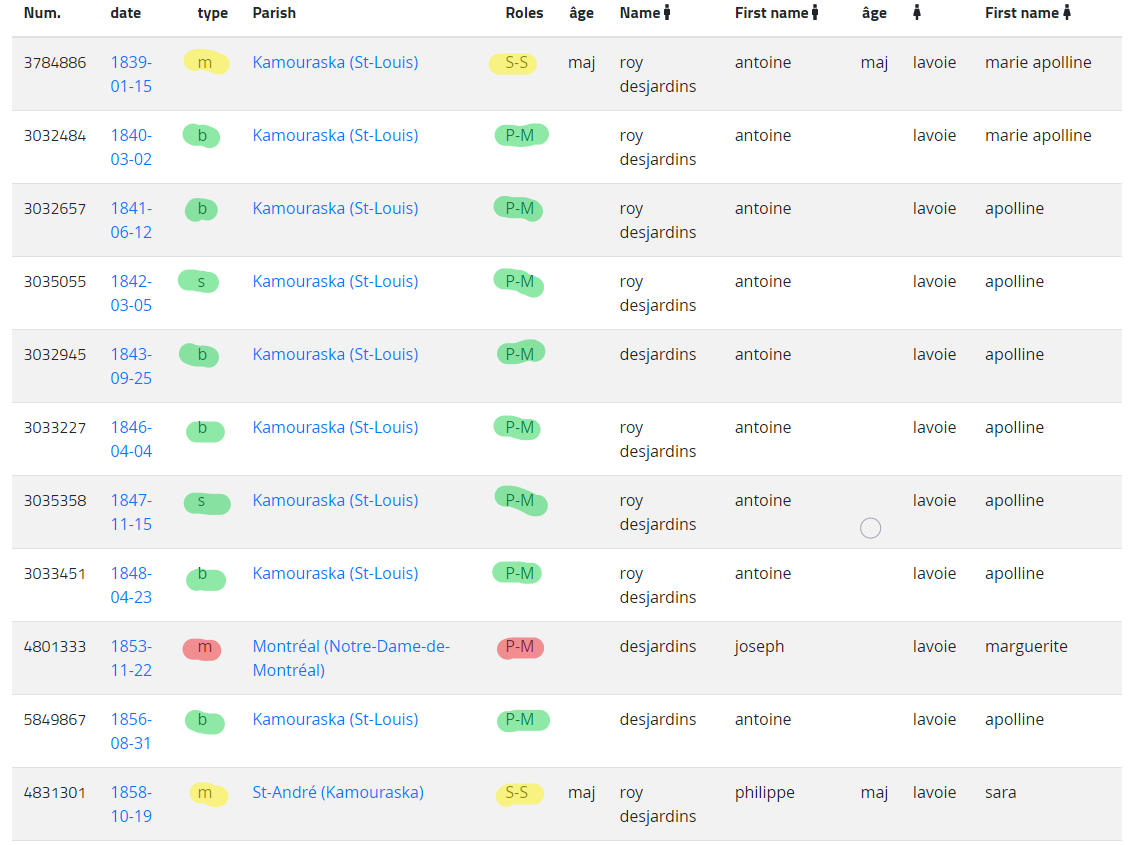
Finally, it is important to know how to interpret the list of results produced by a search on the LAFRANCE. When you carry out a search by Couple, the results will list every record in which the couple is mentioned, regardless of their role in the record. These can be baptism, marriage or burial records, and the couple can play the role of subjects (the spouses) or parents (parents of the spouses, parents of the newborn child or parents of the deceased person).
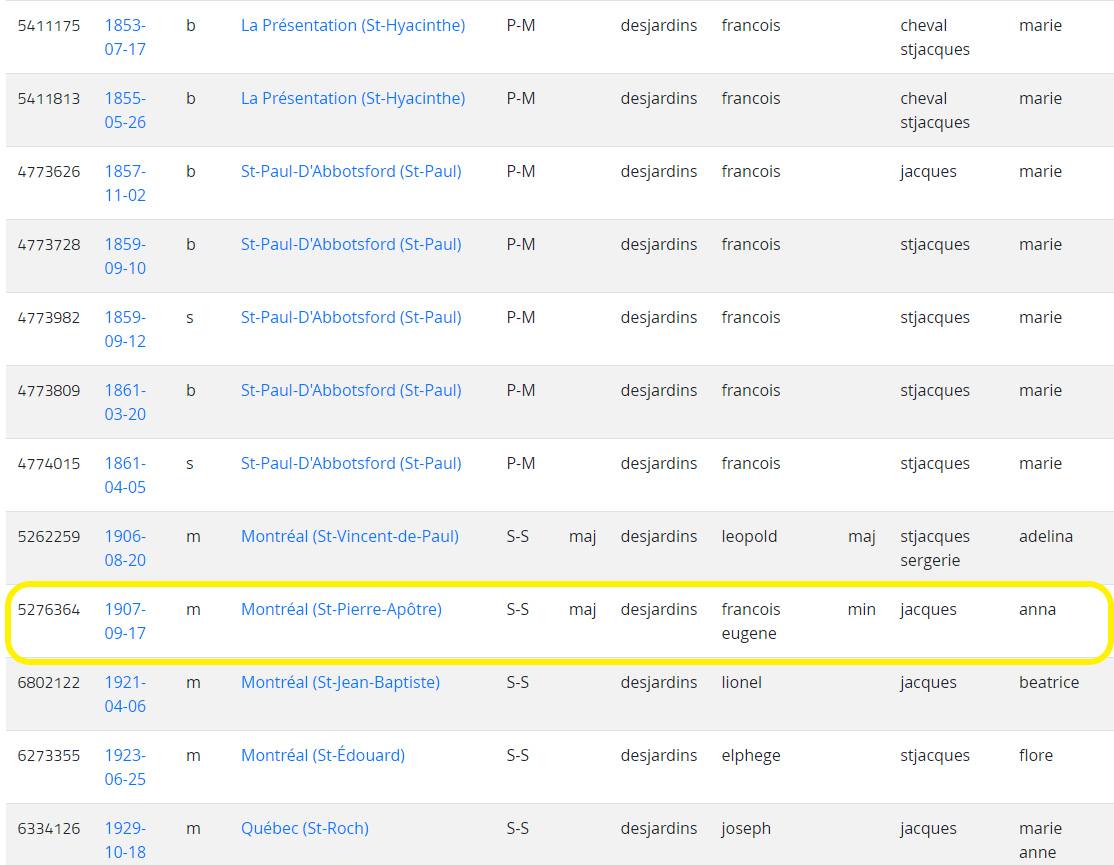
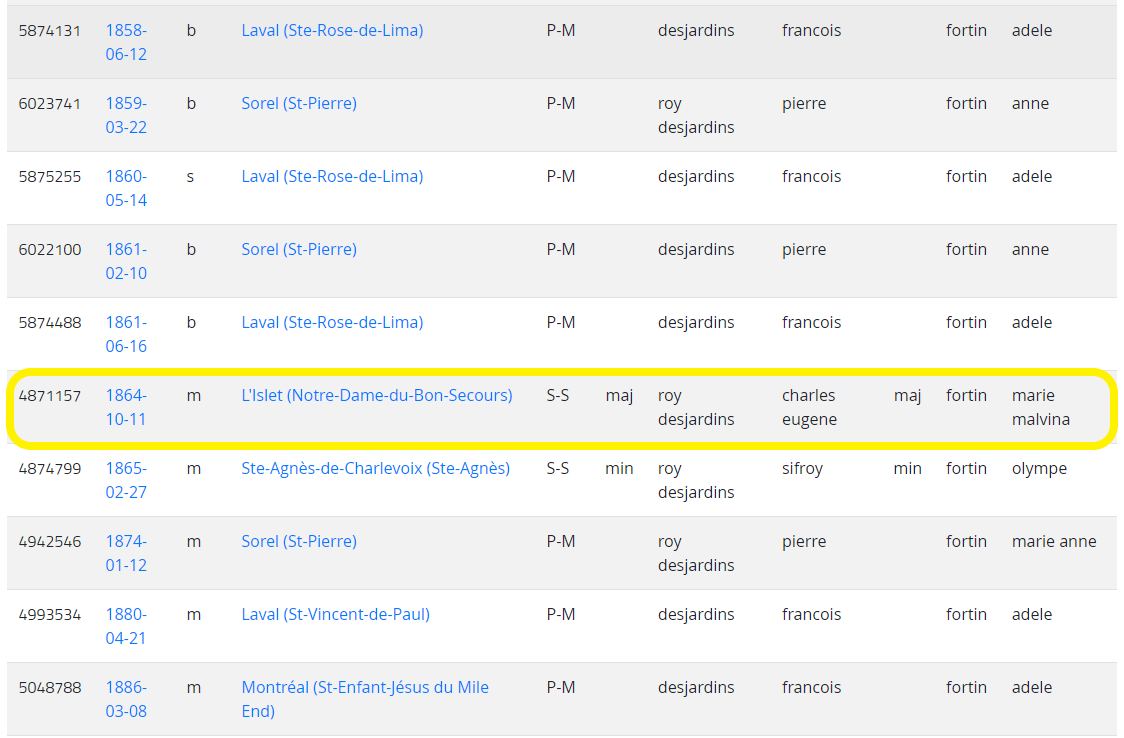
List of results of a search in the LAFRANCE. The marriage records (m) in which the couple we searched for has the role of subjects (S-S) are the ones we will use to trace a lineage
In the list of results obtained from a search on the LAFRANCE, the Type column indicates the type of record in question:
b: baptism
m: marriage
s: burial
The Roles column indicates the role held by the couple in the record:
S-S: Subject-Subject, the spouses
P-M: Father-Mother, the parents
S-C: Subject-Spouse, used when one of the spouses is widowed and the previous spouse is mentioned in the record
As such, in the image above:
The records highlighted in green are baptisms and burials in which the searched couple are the parents
The record highlighted in red is a marriage record in which the searched couple are the parents of one of the spouses
The records highlighted in yellow are marriage records in which the searched couples are the spouses
It is with marriages (m) in which the searched couple are the subjects (S-S) that we will be tracing lineages.
Example case, click to expand
Equipped with the information gathered during the first step, Bertrand is now ready to find the marriage that will serve as the starting point for his research.
Bertrand initially decides to begin his research with the marriage of his parents François-Joseph Desjardins and Suzanne Bertrand. Unfortunately, despite multiple attempts, the marriage does not seem available on the LAFRANCE.
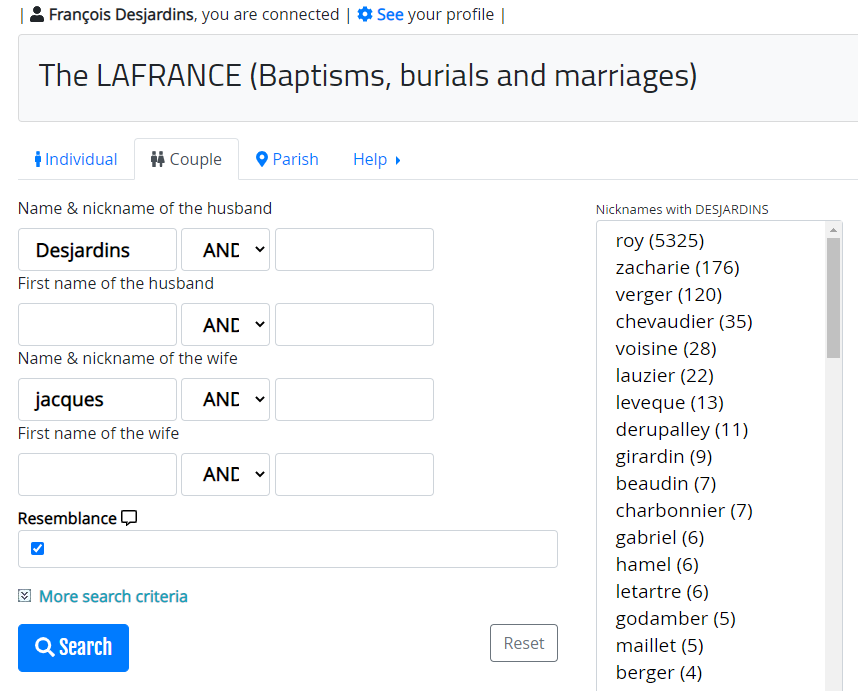
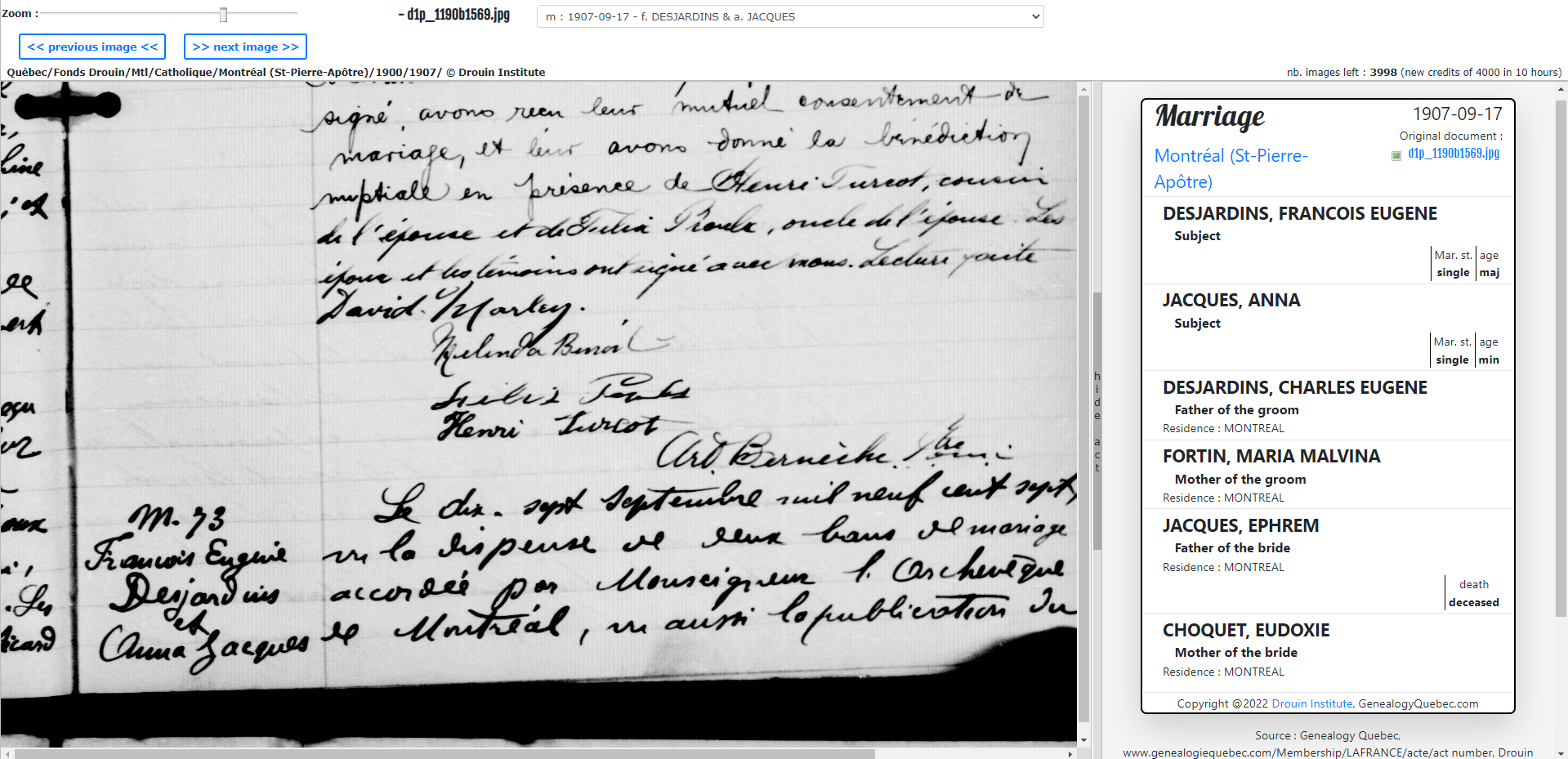
Therefore, Bertrand turns to the marriage of his grandparents, François Eugène Desjardins and Anna Jacques.
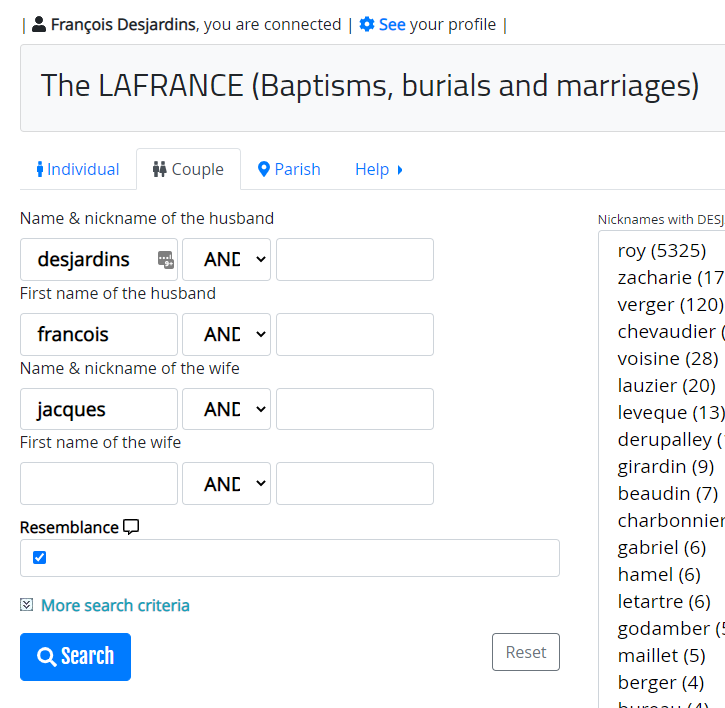
Search parameters entered by Bertrand to find the marriage of his grandparents François Eugène Desjardins and Anna Jacques
Results of the previous search with the desired marriage framed in yellow
François Eugène Desjardins and Anna Jacques’ marriage as found on the LAFRANCE
His search successful, Bertrand now has the information required to go back a generation in his paternal line. To do so, he will have to find the marriage of the parents of François Eugène Desjardins: Charles Eugène Desjardins and Marie Malvina Fortin.
Third step – Going back one generation at a time
With a marriage from your lineage in hand, you are now in a position to find your ancestors. To do so, you will have to find the husband’s (or wife’s) parents marriage, which will allow you to go back a generation.
A simple LAFRANCE search using their names should allow you to do so.
The names of the groom’s parents are listed in the marriage on the left. Searching for them in the LAFRANCE allows us to find their marriage. By repeating the process, we can go back to the first immigrant of a line in Quebec territory.
This process is repeated until you reach the first generation of your line to have set foot in Quebec, often in the 18th or even the 17th century. Depending on your family, you may have more than a dozen generations to trace back before you get to the first immigrant.
Example case, click to expand
Thanks to the marriage of his grandparents found earlier, Bertrand knows that his paternal great-grandparents are Charles Eugène Desjardins and Marie Malvina Fortin. He must now find their marriage using the LAFRANCE.
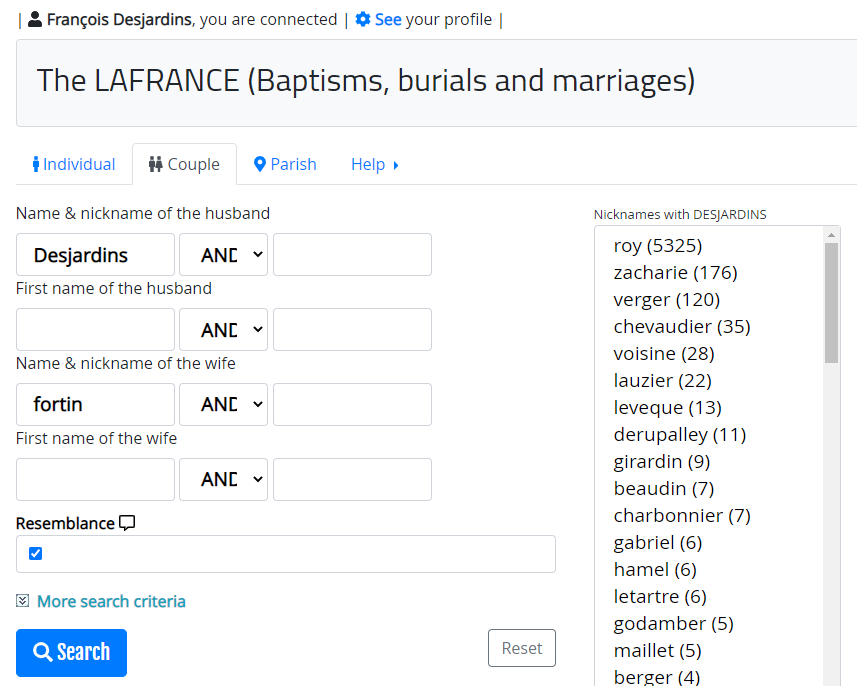
Recommended search for Charles Eugène Desjardins and Marie Malvina Fortin’s marriage in the LAFRANCE
Charles Eugène Desjardins and Marie Malvina Fortin’s marriage highlighted in the results list
Charles Eugène Desjardins and Marie Malvina Fortin’s marriage. Bertrand’s great-grandparents.
Charles Eugène Desjardins’ marriage indicates that his parents are Alexandre Roy Desjardins and Léocadie Gagnon. Bertrand must now find their marriage and repeat the process again and again, until he reaches the first immigrant of his paternal line.
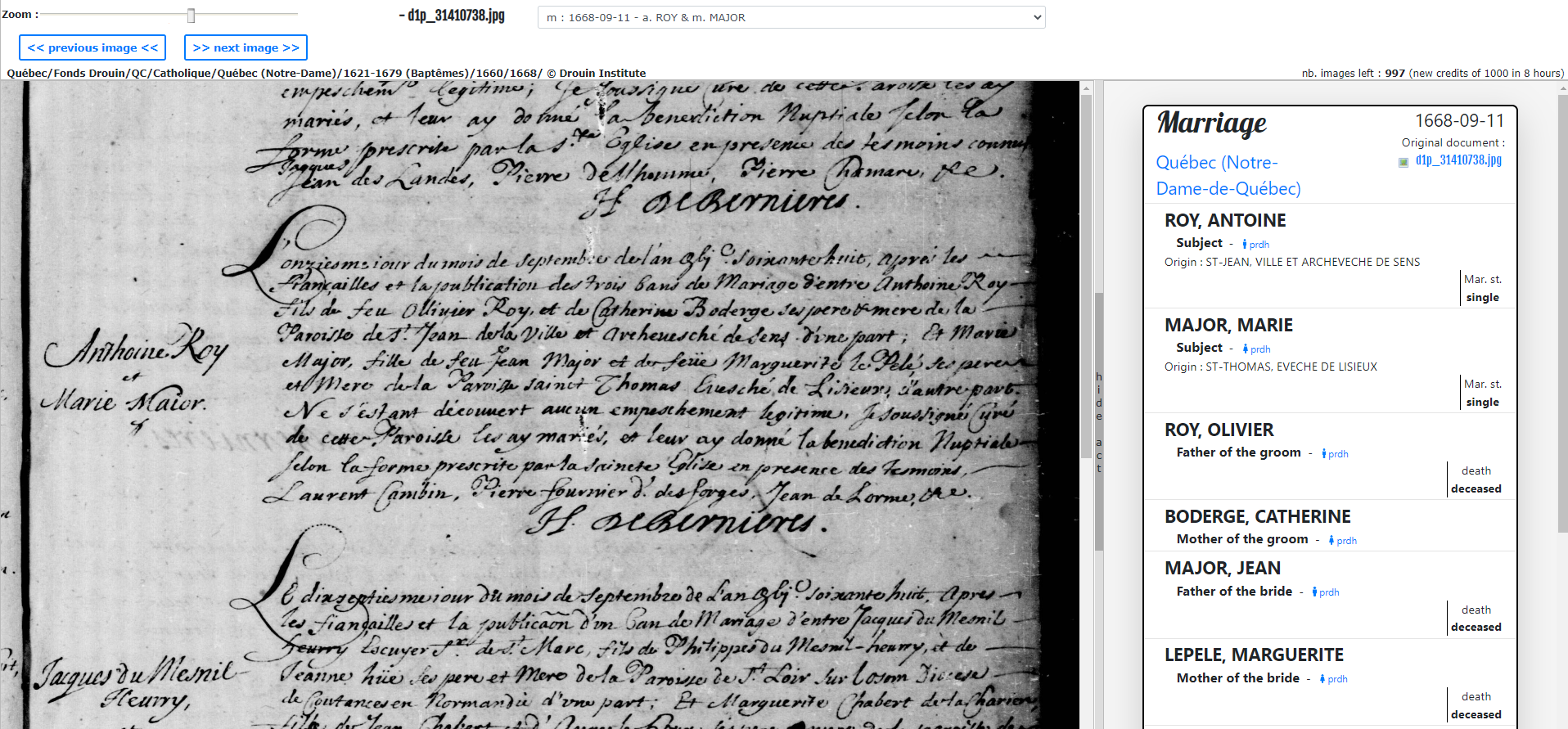
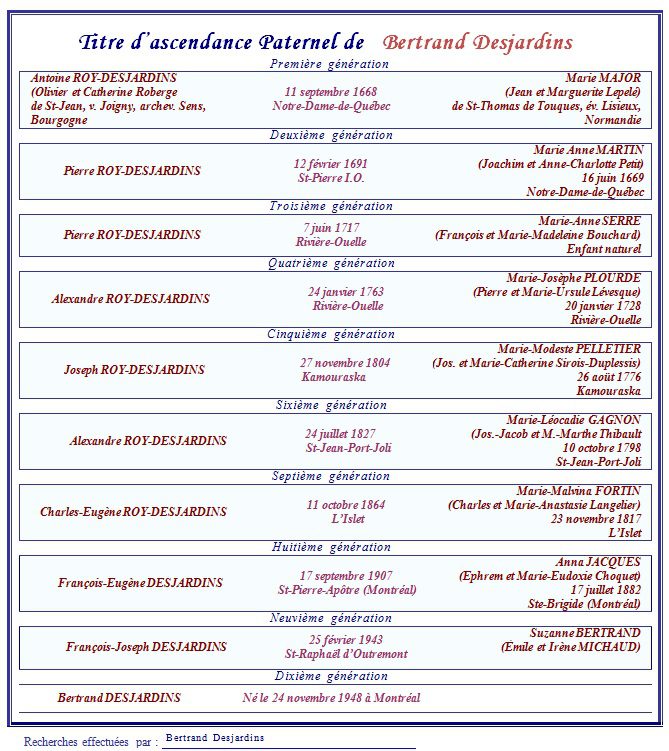
Six generations later, Bertrand finds the marriage of the first immigrant of his line, Alexandre Roy dit Desjardins, who married Marie Major on September 11, 1668 in Quebec.
Antoine Roy (dit Desjardins) and Marie Major’s marriage, the first couple in Bertrand’s paternal lineage to marry in Quebec
Thanks to the LAFRANCE, Bertrand was able to trace his paternal line as far back as the 17th century in minutes.
If you cannot find a marriage in the LAFRANCE
The LAFRANCE contains all Catholic marriages recorded in Quebec prior to 1919, but coverage from 1919 to the present day is not exhaustive. Because of this, you may not be able to find a marriage of your lineage if the information gathered in the first step of your research does not allow you to go back to 1919 or prior.
If this is the case, we suggest that you carry out a search in the LAFRANCE for a death record relating to an individual of the lineage you are researching, since these can also be used as a starting point for your research.
Indeed, death records usually mention the names of the parents of the deceased person. As a result, you could search for the death record of your most distant known paternal ancestor, and obtain the names of his parents from the record, thus allowing you to go back one generation. The next step is to find the marriage of the parents in question, and follow the procedure explained in step two.
Example case, click to expand
Thanks to the information gathered by Bertrand at the start of his research, it was easy for him to find the marriage of his grandparents in the LAFRANCE.
Now imagine a scenario in which Bertrand was unable to gather basic information such as the names of his grandparents. Essentially, Bertrand’s starting point is the names of his parents, their date of marriage, their year of birth and the date of death of his father.
François-Joseph Desjardins, born in 1908, died on September 1st 1963
Suzanne Bertrand, born in 1919, died on December 31st 2014
Married in 1943 in Montreal
The marriage of Bertrand’s parents can be found in the LAFRANCE, but it does not contain the names of his grandparents; it’s a dead end.
Therefore, Bertrand turns to death records. A LAFRANCE search for a Desjardins who died in 1963 allows Bertrand to find his father’s death record.
François Desjardins’ death record found in the LAFRANCE
The record indicates that the names of François-Joseph Desjardins’s parents are F. Desjardins and A. Jacques. A search for a Desjardins/Jacques couple in the LAFRANCE leads to their marriage, which will serve as Bertrand’s starting point in his attempt to trace his paternal line.
Do not hesitate to contact us at contact @ institutdrouin.com if you have any questions regarding this guide or the process of retracing your ancestors.
⚠️ Note: This guide pertains to one of Genealogy Quebec’s legacy tools, which are no longer updated. Their content is now integrated into the new unified search engine.
The Drouin Institute’s Family Genealogies section contains 660 family genealogies produced by the Drouin genealogical Institute over the course of the 20th century. These 660 genealogies total for over 230 000 pages. 203 genealogies are indexed by couple.
This section is separated in 2 categories.
Marriage search in the Family Genealogies
The marriages included in the Family Genealogies have been indexed and can be searched by the name of the spouses, the date of the marriage, or the name of the family for which the genealogy was produced.
Family Genealogies
The entire content of the Family Genealogies is presented in a file tree. The different sections are organized via separated folders.
You can browse the Drouin Institute’s Family Genealogies with a subscription to Genealogy Quebec at this address.
⚠️ Note: This guide pertains to one of Genealogy Quebec’s legacy tools, which are no longer updated. Their content is now integrated into the new unified search engine.
The Drouin Institute’s Great Collections, one of 15 tools available to Genealogy Quebec subscribers, contains a digitized version of the Great Collections published and edited by the Drouin Institute over the course of its existence.
Masculine (Men series): Alphabetical directory of all French-Canadian marriages from Quebec between 1760 and 1935, sorted by the groom’s surname.
Féminine (Woman series): Alphabetical directory of all French-Canadian marriages from Quebec between 1760 and 1935, sorted by the bride’s surname.
Histor: Directory of marriages files, including the origin of the subjects as well as a marriage contract. This collection covers all the Catholic and Protestant marriages celebrated in Quebec between 1730 and 1825, as well as marriages celebrated in Western French forts such as Détroit. Also contains Acadian marriages.
Fiches Acadiennes (Acadian cards): This series contains 50 000 birth, marriage and death cards pertaining to Acadian individuals.
Dossiers généalogiques Drouin: Contains the data collected before 1960 by Joseph and Gabriel Drouin in order to create their family genealogies.
Affinités généalogiques Drouin: Complement to the Dossiers généalogiques Drouin, contains various genealogical and historical documents.
Petit Drouin: Directory of all of Quebec’s Catholic marriages from 1760 to 1825.
Kardex Noir: The Kardex Noir was the predecessor to La Masculine (Men Series). Its content is similar.
Prévôté de Québec: Contains transcriptions of Prévôté de Québec hearings.
DNCF: Contains the 4th book of the Dictionnaire national des Canadiens francais (Red Drouin)
Patrimoine familial: This series presents the lives and genealogies of some famous or significant Quebec historical figures.
Patrimoine national: Contains baptism, marriage and burial directories as well as some Quebec cemeteries, produced by various authors.
Fiches franco-américaines (Franco-american cards): These cards contain an index of individuals who have been mentioned in the Guide Officiel Franco-Américain. The Guide Officiel Franco-Américain (GOFA) was a guide published annually in the United States that pertained to French-Americans. It contained short biographies of individuals with French roots living in the United States.
This tool can be browsed in two different ways.
Search by family in the Great Collections
The search by family in the Great Collections allows you to search for a surname in one or many of the following collections:
La Masculine (Men Series)
La Féminine (Women Series)
Le Fichier Histor
Dossiers généalogiques Drouin
Fiches Acadiennes (Acadian cards)
Petit Drouin
After searching for a surname, you will obtain a list of results that includes every page where this family name is mentioned in the above collections.
The results are presented in the same alphabetical order in which they appeared when the Great Collections were published as books, meaning that an individual whose first name begins with A will appear on the first few pages, while an individual named Zenophile should be found on the last pages.
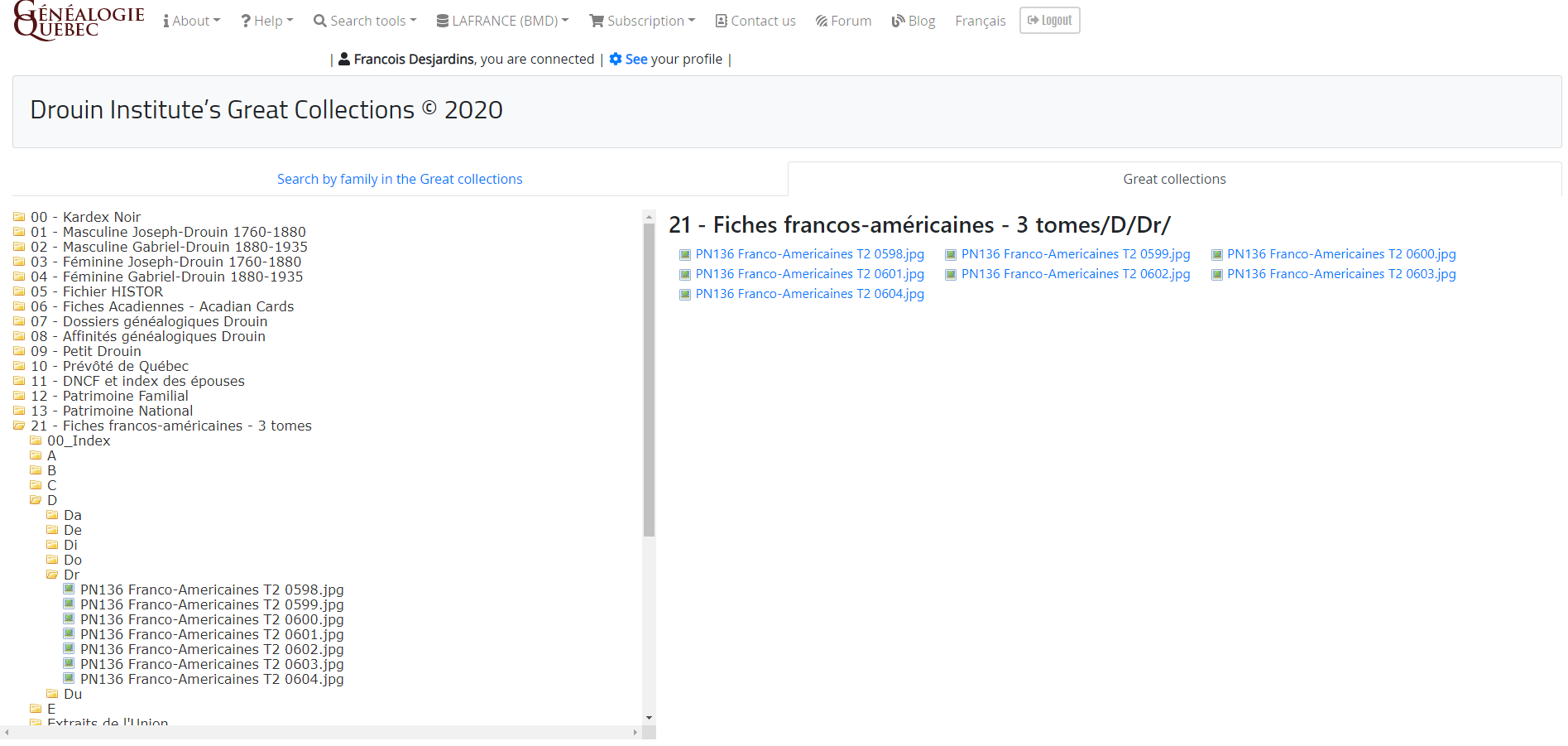
Great Collections by folders
In this tab, the collections are organized within a file tree structure.
The collections can be browsed by navigating through the folders.
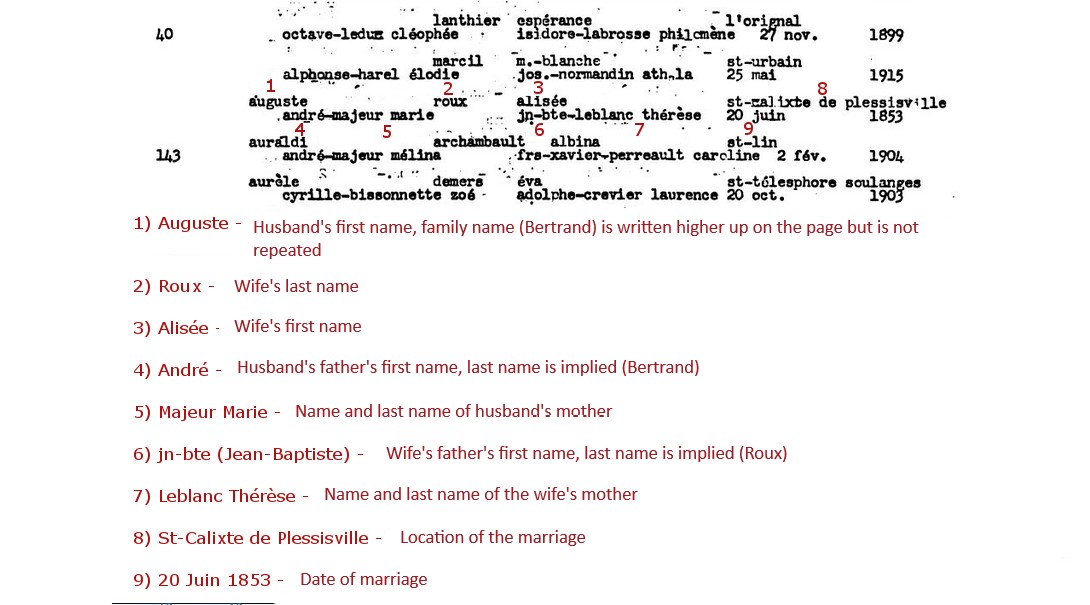
Some of the documents contained in these collections, namely the Men and Women series, aren’t particularly intuitive for a novice user.
Here is a schema explaining how to interpret the documents from these two collections:
Buying a physical copy of the Drouin Great Collections
Physical book versions of the Great Collections can still be purchased to this day. They are mainly intended for genealogical societies and libraries but are also available to private individuals.
Please note that we are now offering significant discounts on the Great Collection books. To inquire about the discounts, please write to us at contact@institutdrouin.com.
Finding the original church records referenced in the Men and Women series
Your subscription to Genealogy Quebec gives you access to the Drouin Collection Records, which contain all of Quebec’s parish registers from 1621 to the 1940s as well as many parish registers from Ontario, Acadia and the Northeast of the United States.
Every marriage referenced in the Men and Women series refers to an original parish document; it is therefore possible, in most cases, to find the original document from the information contained in the Men and Women Series.
To illustrate the process of finding an original document, we will use Ferdinand Gallichant and Marie-Anne Brochu’s marriage.
galichaut – Groom’s last name
joseph-ferdinand – Groom’s first name
brochu – Bride’s last name
m.-anne – Bride’s first name
n.-d.-québec – Parish where the marriage was recorded
3 avril 1929 – Date of marriage
The Men Series entry for this marriage indicates that it was celebrated on the 3rd of April 1929 in the Notre-Dame de Québec parish.
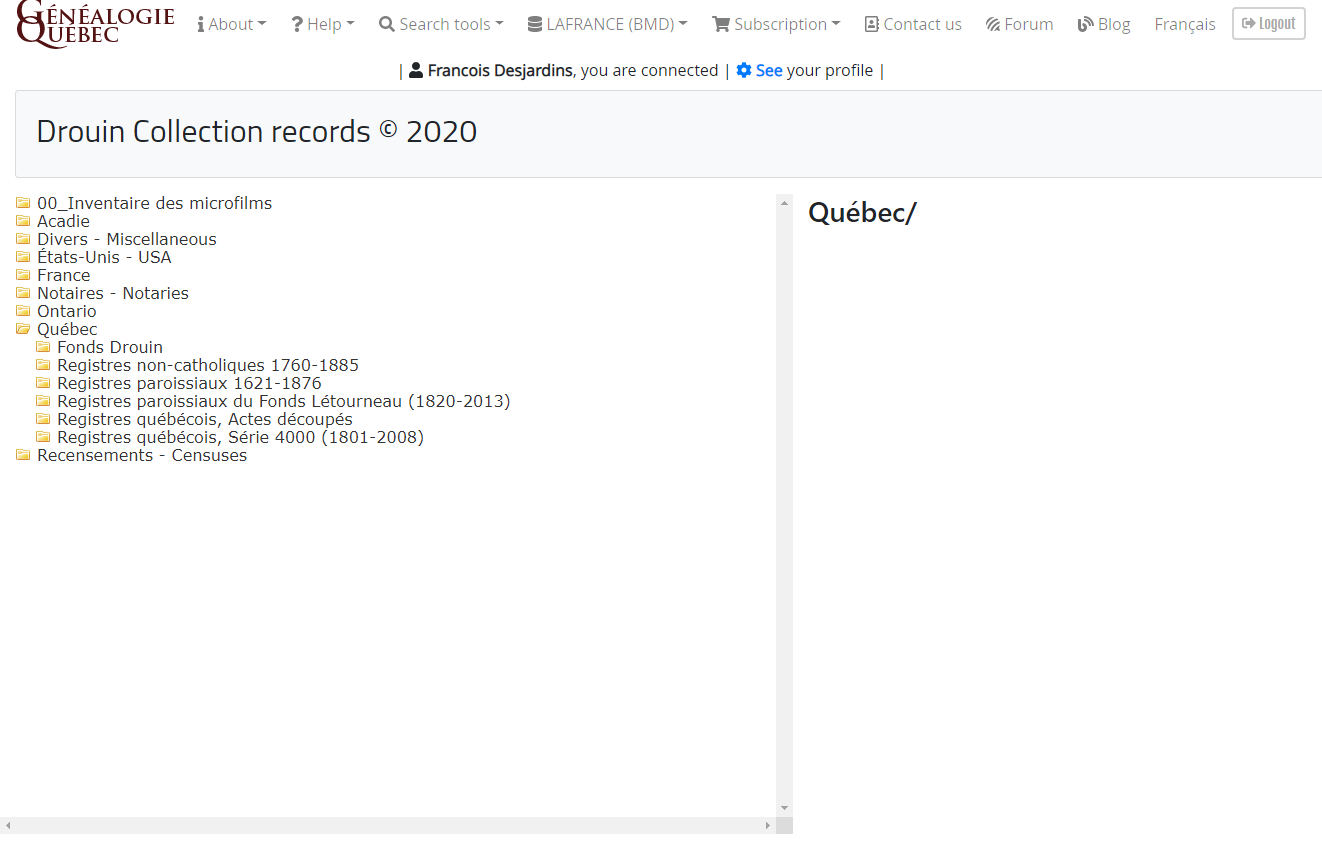
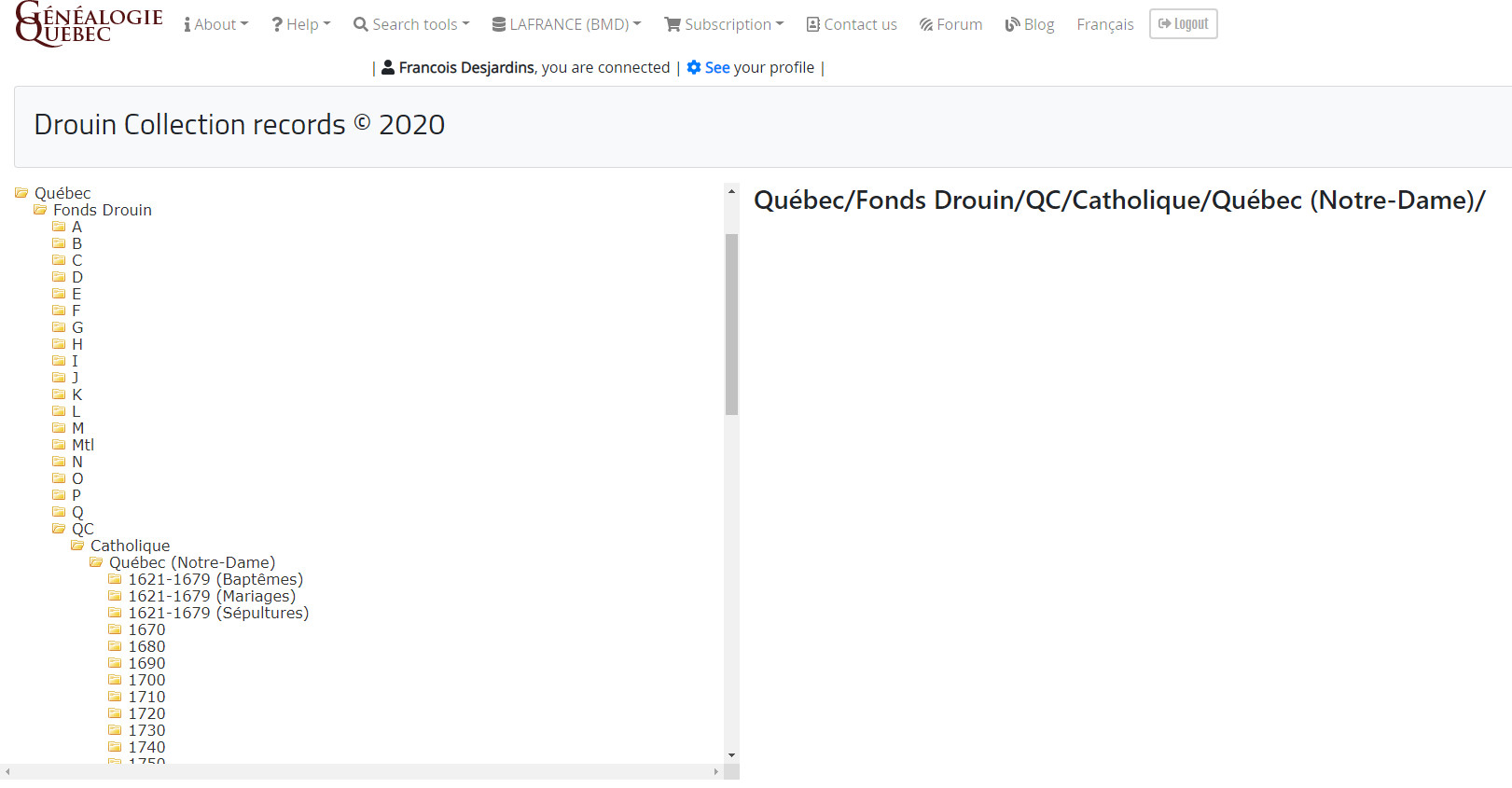
Once in the Drouin Collection Records, you will notice that the various registers are organized in a file tree structure. We begin by opening the Quebec folder, as the marriage we are interested in was recorded in that province.
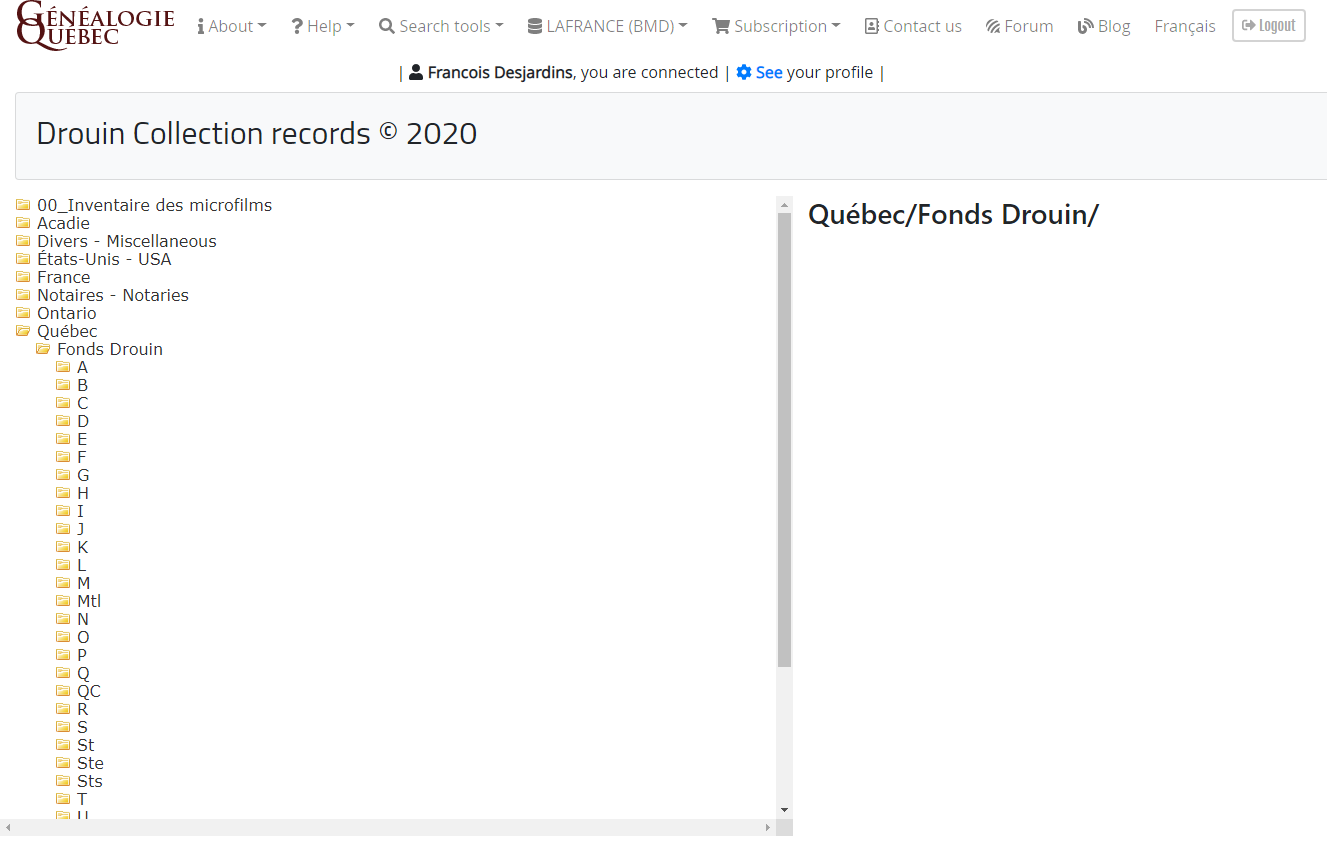
It is under the Fonds Drouin folder that you will find all of Quebec’s parish registers from 1621 to 1940, sorted by alphabetical order.
We must now find the Notre-Dame-de-Québec register folder.
Some parishes are listed under the name of the city they are in, while others will be listed under the name of the parish itself. All of Quebec City’s parishes can be found under the “QC” folder, listed according to their religious denomination.
As Notre-Dame-de-Québec is a Catholic parish, it will be found under the “catholique” folder.
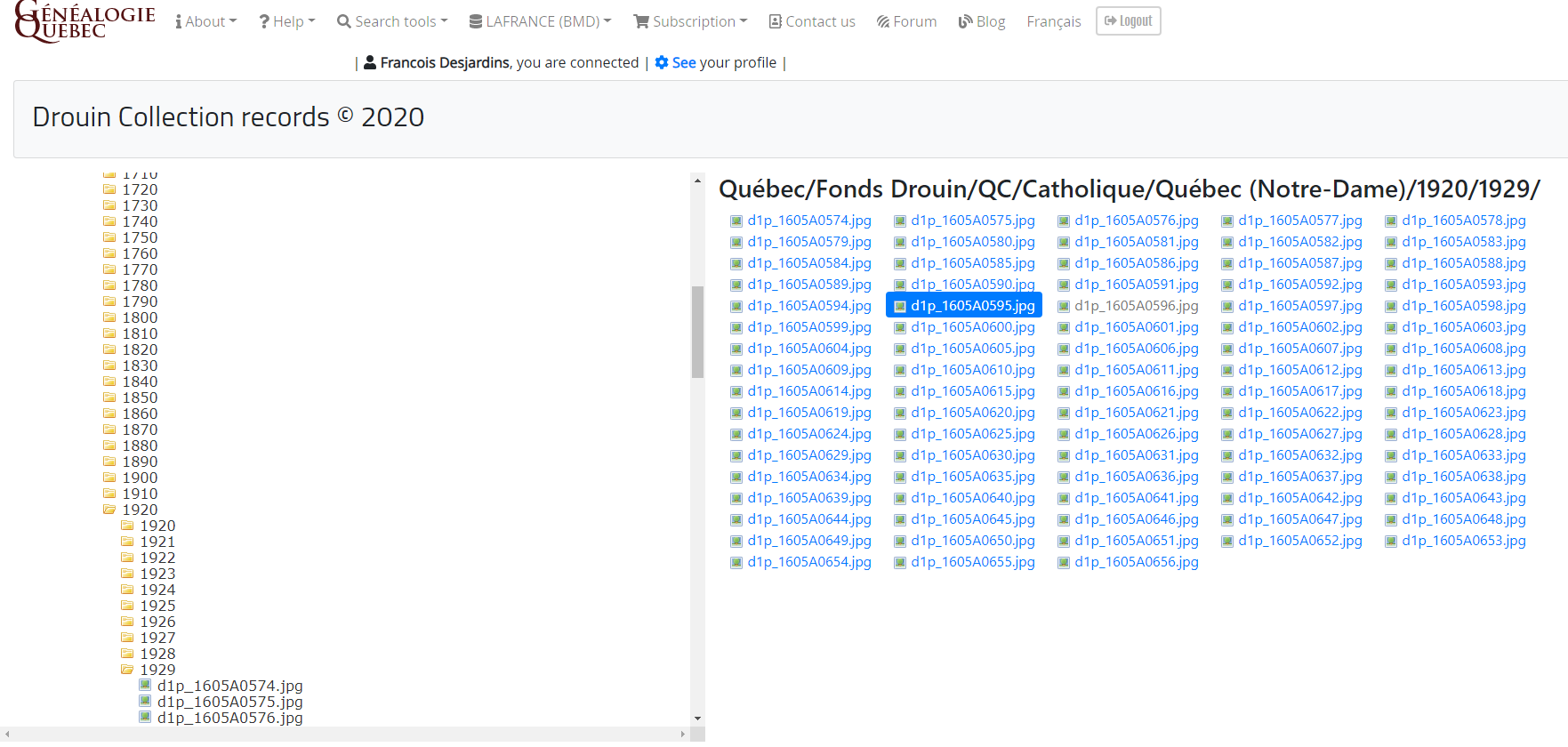
Once inside the folder, we must navigate to the correct year, which will give us access to all the images associated with the register for that specific year. It is important to know that in general, the images are listed in chronological order within a folder.
This means that the first image in the folder will contain the first events recorded during that year, which are usually the ones from January. Similarly, the last few images in the folder will hold the records from the end of the year.
As Ferdinand Gallichant and Marie-Anne Brochu’s marriage was celebrated in April, the 4th month of the year, our consultation of the register should begin within the first third of the list of images.
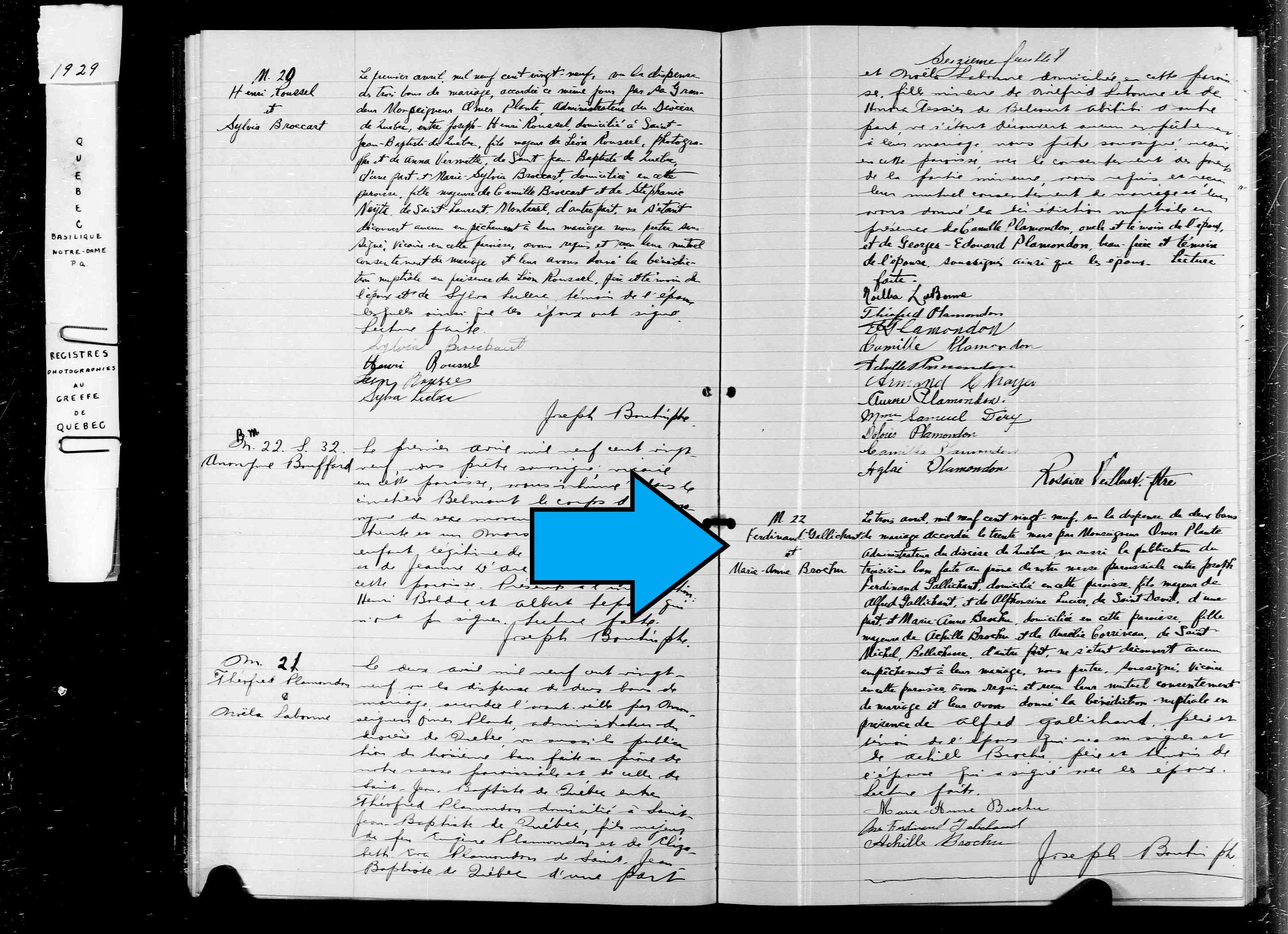
And so, we were able to find the original document pertaining to a Men Series entry using the tools available on GenealogyQuebec.com.
⚠️ Note: This guide pertains to one of Genealogy Quebec’s legacy tools, which are no longer updated. Their content is now integrated into the new unified search engine.
The Acadia – Families tool contains family files based on original Acadian records. It is one of the 15 tools available to Genealogy Quebec subscribers.
In total, this tool contains 171,246 family files. Currently, these cover a period that spans from the beginning of the Acadian colony to the end of 1849. In addition, 38 locations covering from 1850 to the end of the available registers are included. A list of these locations is available at the end of this article.
The files usually contain the names and first names of the parents, the first name of the child, the dates of birth and/or baptism, of death and/or burial, and of marriage (a total of 328,623records). Links to the original church documents pertaining to the baptisms, marriages and burials mentioned in the file are also often available.
Family file from the Acadia – Families tool. Click on the blue links to view the original documents.
Original document from Acadia – Families
The files are constantly changing as locations are being added to the collection. Thus, we recommend that you revisit the family files pertaining to your ancestors whenever the tool is updated.
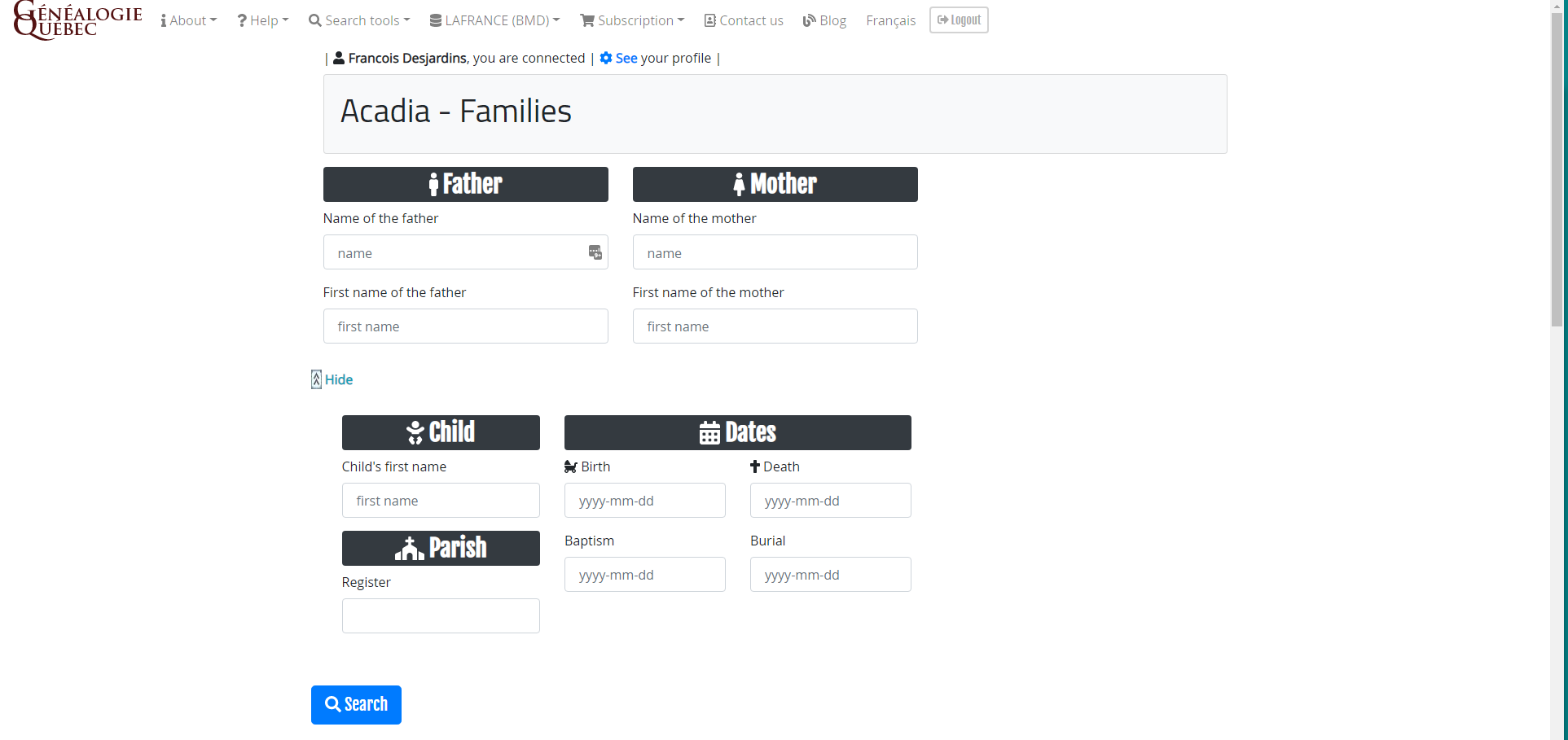
The tool is equipped with a search engine that allows searching by first and last names, dates and parish.
Acadia – Families search engine
n. – birth
b. – baptism
d. – death
inh. – burial
m. – marriage
PrNH. – First nations male
PrNF – First nations female
Locations
Acadie et Gaspésie (complet)
Acadieville (complet au 4 fév 1900)
Arichat (31 déc 1849)
Baie Ste-Marie Cap-Sable (complet)
Baie-Ste-Marie (complet)
Barachois (31 déc 1849)
Bartibogue (complet au 23 avril 1900)
Balmoral (complet 31 déc 1899)
Barnaby-River (complet 22 juil 1900)
Bathurst-Est (complet au 14 jan 1900)
Bathurst-Ouest (complet au 23 jan 1900)
Beaubassin (complet)
Belledune (complet au 22 jan 1900)
Bouctouche (complet au 31 déc 1900)
Blackville (31 déc 1849)
Caraquet (complet au 14 jan 1900)
Central Kingsclear (31 déc 1849)
Chatham (complet au 28 jan 1900)
Charlo (complet au 20 fév 1900)
Cocagne (complet au 31 déc 1899)
Dalhousie (complet au 31 déc 1918)
Ecouipahag (complet)
Eel-Ground (complet au 19 juin 1912)
Escuminac (complet au 18 fév 1906)
Fort St-Jean (complet)
Frédéricton (31 déc 1849)
Gloucester (31 déc 1849)
Grande-Digue (31 déc 1849)
Ile-Royale (complet)
Ile-St-Jean (complet)
Lamèque (31 déc 1900)
Loch-Lomond (31 déc 1849)
Lower-Caraquet (complet au 31 déc 1899)
Louisbourg (complet)
Memramcook (16 jan 1900)
Milltown (31 déc 1849)
Moncton (21 janv 1900)
Nash Creek (complet 31 déc 1890)
Néguac (31 déc 1849)
Nelson (complet au 25 fév 1900)
Newcastle (complet au 31 déc 1899)
Paquetville (complet au 31 déc 1899)
Petit-Rocher (complet au 9 janv 1900)
Pokemouche-en-Bas (complet au 31 déc 1899 )
Pokemouche-en-Haut (complet au 1 janv 1900)
Port-Royal (complet)
Red-Bank (31 déc 1849)
Remous-Bridge (complet au 3 sept 1893)
RichibouctouG (St-Louis-de Gonzague)(complet au 31 déc 1899)
RichibouctouP (St-Antoine-de-Padoue)(complet au 31 déc 1899)
Rivière-Jacquet (complet au 22 janv 1900)
Robertville (complet au 31 déc 1899)
Rogersville (complet au 17 août 1898)
Sackville (complet au 11 fév 1900)
Shemogue (31 déc 1849)
Shippagan (complet au 21 janv 1900)
St-Andrew (31 déc 1849)
St-Anselme (31 déc 1849) (Prochain site de lecture)
St-Basile (31 déc 1849)
St-Charles-Borromée (complet au 31 déc 1899 + 4 mariages en 1900)
⚠️ Note: This guide pertains to one of Genealogy Quebec’s legacy tools, which are no longer updated. Their content is now integrated into the new unified search engine.
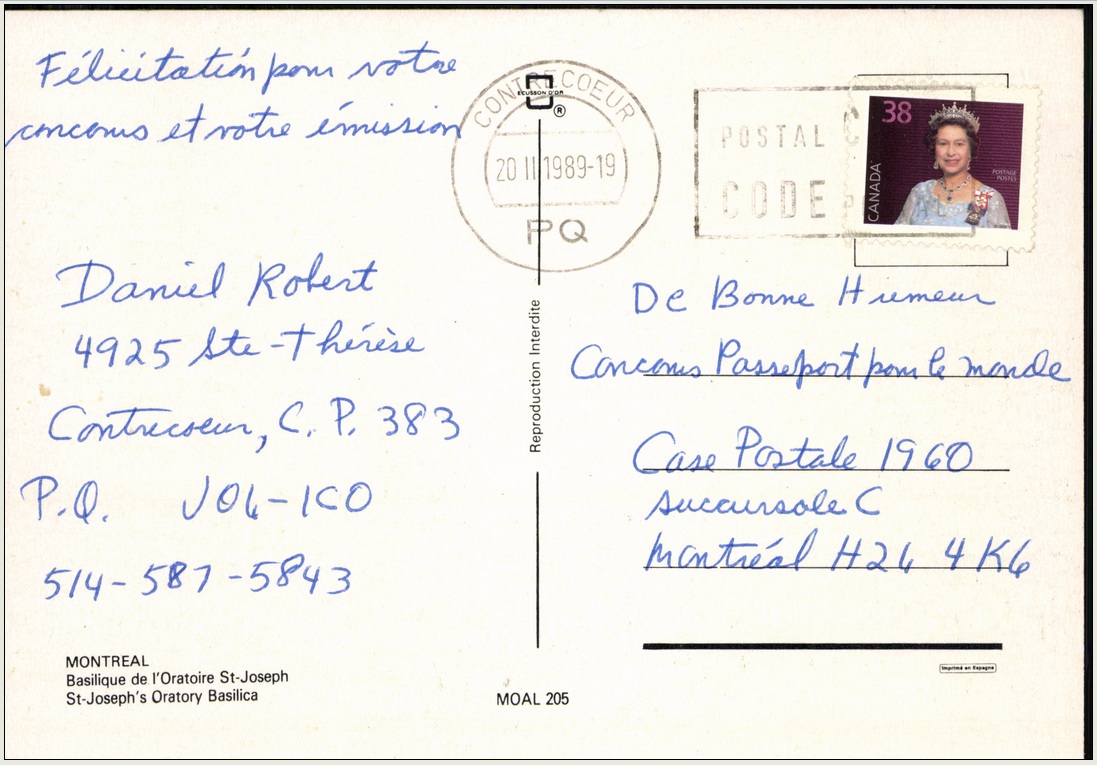
The Postcards tool contains around 256 000 postcards from Quebec and the surrounding area. Both sides of the card are available.
The tool extends throughout the 20th century, but most of the postcards are dated between 1980 and 2002.
Postcard sourced from the tool of the same name
Postcards are indexed by the name of the sender and the recipient of the card. A search engine allows you to search by first and/or last name.
You can browse the Postcards tool with a subscription to Genealogy Quebec at this address.
⚠️ Note: This guide pertains to one of Genealogy Quebec’s legacy tools, which are no longer updated. Their content is now integrated into the new unified search engine.
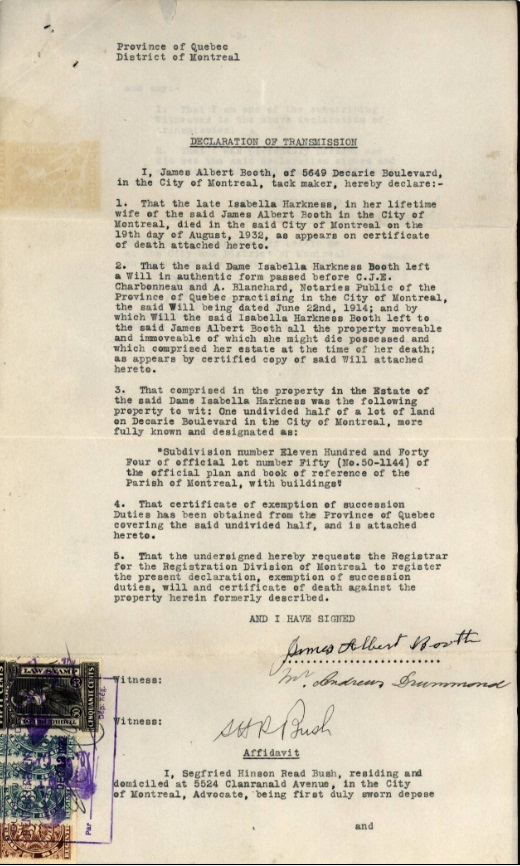
The Notarized documents tool contains 83 000 notarized documents indexed by type of document, names given in the document, name of the notary as well as date and location. The original documents have also been digitized and can be viewed within the tool.
Notarized document sourced from the collection of the same name
The collection’s coverage extends to the whole province of Quebec for the 19th and 20th century period.
The search engine integrated within the tool provides multiple fields to help narrow down your search.
Field name :
Research type :
Explanation :
Type of document
Contains
Type of document (eg. Sale)
Notaries
Contains
Name of the notary (eg. Poirier)
Mentioned names
Contains
Mentioned names in the document (eg. Sébastien)
Mentioned places
Contains
Mentioned places in the document (eg. St-Lin)
Dates
Contains
Mentioned years in the document (eg. 1936)
To begin your research, fill the search fields and click on the “Search” button. The results will appear on the right side of the page. If the search produces too many results, fill more fields. If it produces no results, make it less precise.
To get to the original document, click on the name of the document you want to view.
You can browse the Notarized documents collection with a subscription to Genealogy Quebec at this address.
⚠️ Note: This guide pertains to one of Genealogy Quebec’s legacy tools, which are no longer updated. Their content is now integrated into the new unified search engine.
The Connolly File is one of 15 tools available to Genealogy Quebec subscribers. It is an index of Catholic and Protestant baptisms, marriages and burials from Quebec and part of the United States covering a period extending from 1621 to today. In total, the tool contains 6,839,262 baptism, marriage and burial files.
Using the Connolly File
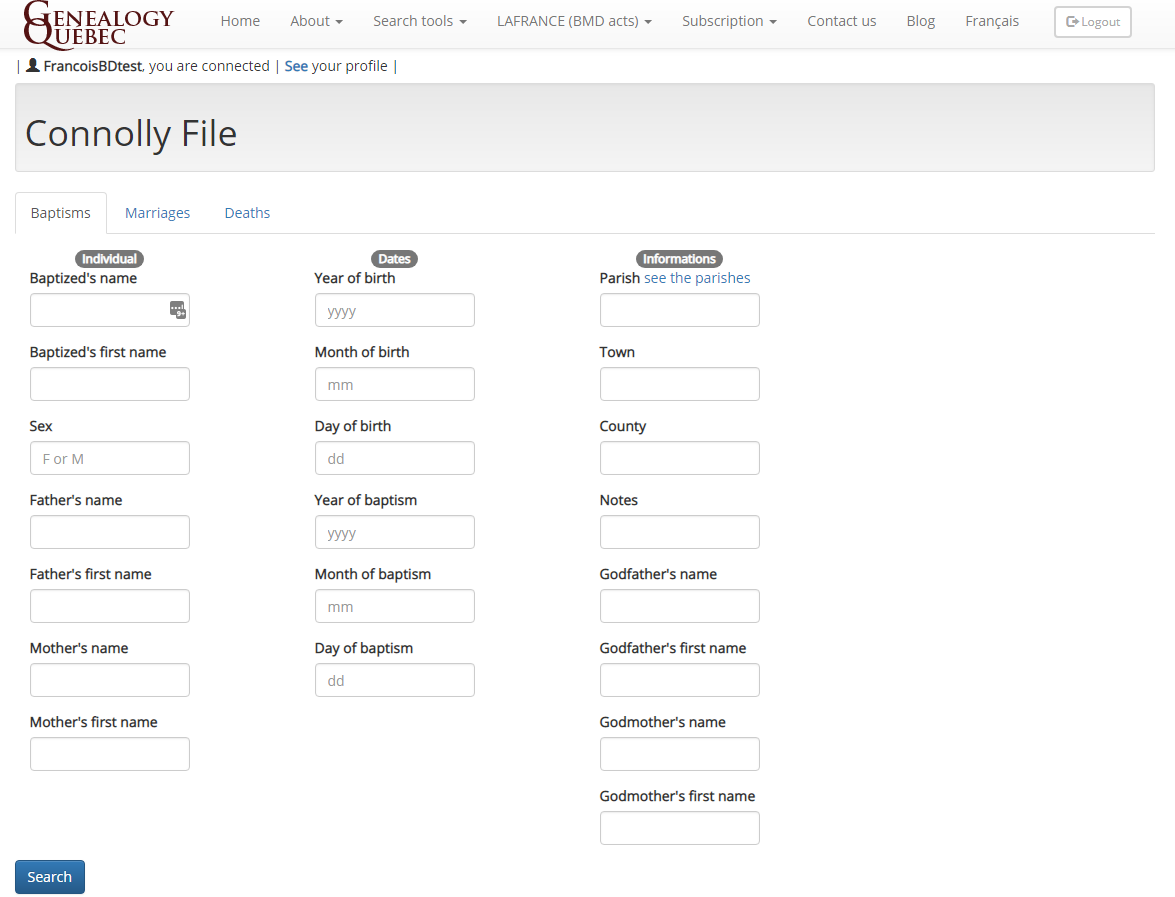
The Connolly File is equipped with a search engine specific to each type of record it contains, namely baptisms, marriages and burials. The search fields differ depending on the type of record searched, but the basic name, surname, date and location fields are always present.
Connolly File baptism search engine
To begin your search, fill one or multiple search fields and press on “Search”, which will prompt a list of results.
Result list produced by a search for “Pierre Loiselle”
The records are presented as files which contain all of the relevant information extracted from the original record.
Automatic search buttons
Every record in the Connolly File is equipped with one or several automatic search buttons. These buttons allow you to automatically trigger searches for various records related to the one you are viewing. In the baptism section, the automatic search button allows you to search for the parents’ marriage record.
In the marriage section, there are 6 different buttons per file. These buttons will trigger automatic searches for the parents, the baptism records or the burial records of the subjects.
Finally, the burial section will let you automatically search for the subject’s own marriage, or that of their parents.
Careful! If an automatic search does not yield any results, do not assume that the desired record does not exist in the Connolly File. For example, it is very possible that an individual’s name may be slightly different from one record to the next, or that the Priest committed a mistake when recording the original event. It is strongly recommended to do a manual search if the automatic search produces no results, and to try multiple combinations of first and last names if the initial searches are unsuccessful.
Tips and best practices
The Connolly File allows searching for many variables, which makes it tempting to fill as many fields as possible when using the tool. However, we recommend that you keep your initial search as vague as possible, and clarify it as needed by adding one piece of information at a time. When the name or surname searched is rare or unusual, it is rarely necessary to add more information to the search.
The more precise a search is, the more likely it is to omit the record you are looking for, as every single field must match. For example, an initial search could start with the surname and first name of the subject. If the number of results is too high, a variable such as the year of the event or the surname of another individual mentioned in the record can be added. Often, the simple fact of adding a third variable is enough to narrow the search down sufficiently.
As with many of Genealogy Quebec’s tools, you may use the “%” character as a joker to search for a partial name. For example, a search for “Lar%” will include any name beginning in “Lar”, such as Larrivière, Larramée, Larue, etc. This allows you to keep your search more generic and is particularly useful for surnames that tend to have many different spellings.
Finding the original record using the information provided by the Connolly File
You may have noticed that the Connolly File does not provide a link to the original document from which its files have been created. However, as a Genealogy Quebec subscriber, you have access to the entirety of Quebec’s Parish Registry up until 1940 through the Drouin Collection Records. You can find most of the original documents associated with the Connolly File records via the date and parish name given in each record.
As an example, here is the baptism file of Jean-Louis Girard.
It tells us that Jean-Louis was born in Bagotville on October 10, 1923, and was baptized in the St-Alphonse-de-Liguori parish. To find the original record, we must browse this parish’s register for the year 1923, which we will find in the Drouin Collection Records.
Once in the Drouin Collection Records, you will notice that the various registers are organized in a file tree structure. We will begin by opening the Quebec folder, as the baptism we are interested in was recorded in the province. Once inside the Quebec folder, we have to find the right parish folder. Some parishes are listed under the name of the city they are located in, while others will be listed under the name of the parish itself. In the case of St-Alphonse-de-Liguori parish, it is listed under Bagotville.
Once inside the correct folder, we must navigate to the right year, which will give us access to all the images associated with that register for that specific year. It is important to know that in general, the images are listed in chronological order. This means that the first image in the folder will contain the first events recorded in that year, which are usually the ones from January. Similarly, the last few images in the folder will be those from the end of the year. Since Jean-Louis’s baptism was celebrated in October, it’s likely that his baptism will be found among the last few images. You may have to sift through a few pages before finding the right one, but by starting towards the end, you will save yourself some time.
And with that, we were able to find the original document using the information given to us in the Connolly File record.

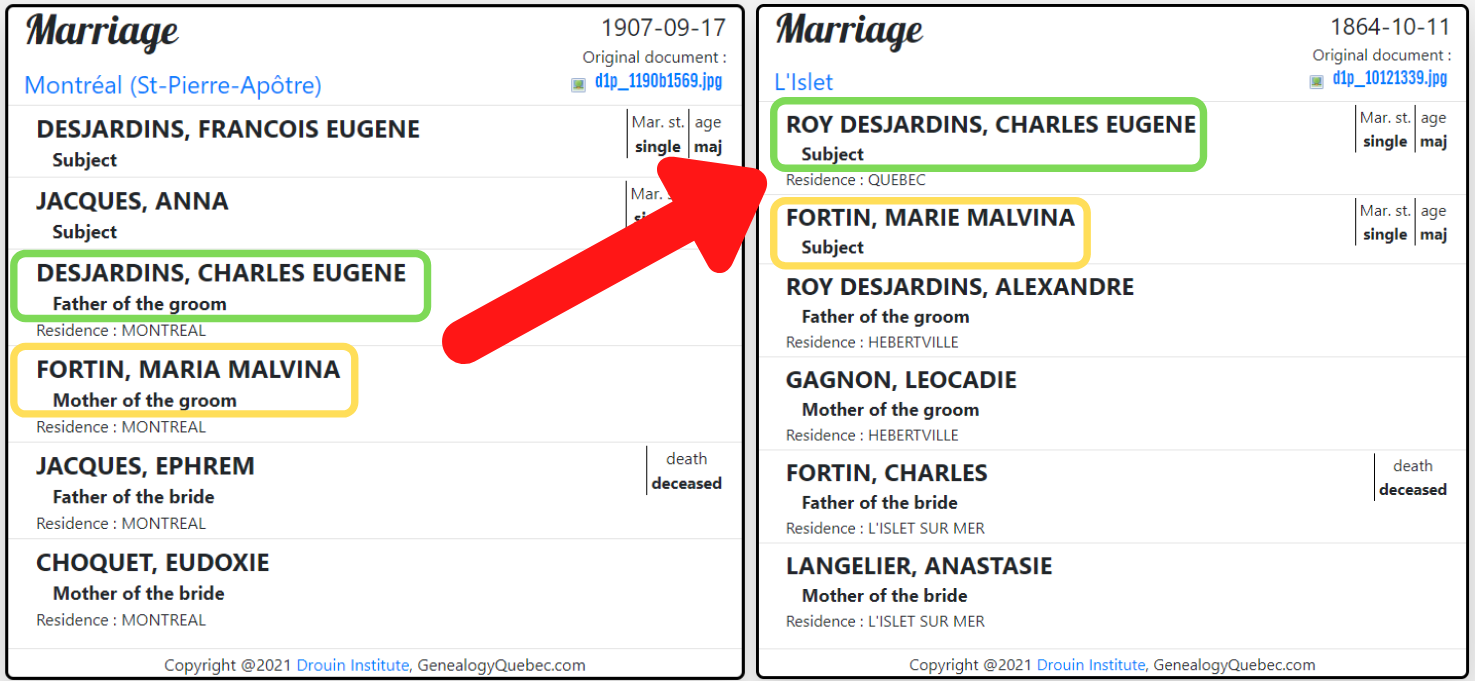 The names of the groom’s parents are listed in the marriage on the left. Searching for them in the LAFRANCE allows us to find their marriage. By repeating the process, we can go back to the first immigrant of a lineage in Quebec territory.